Istorie
The G-class was developed as a military vehicle from a suggestion by the Shah of Iran (at the time a significant Mercedes shareholder) to Mercedes and offered as a civilian version in 1979.
In 1983 a specially modified 280 GE won the Paris–Dakar Rally driven by Jacky Ickx and Claude Brasseur.
Full description
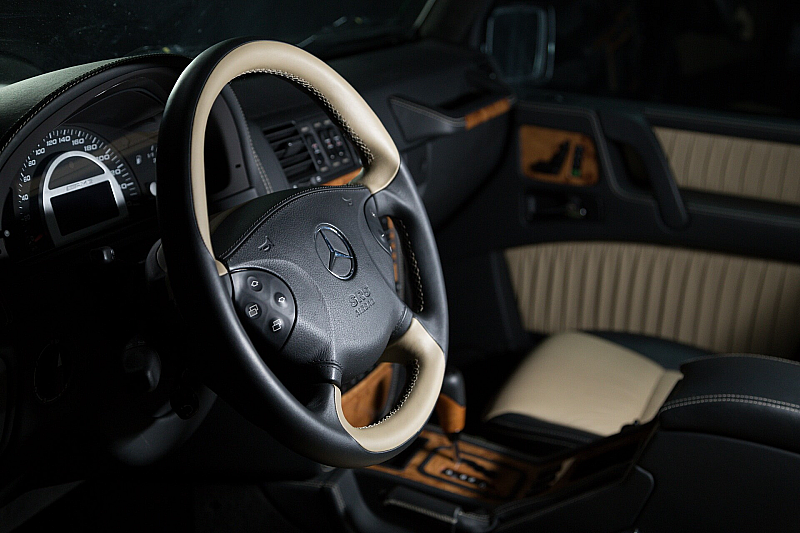
Born out of a joint venture in 1979 between Mercedes-Benz and two other companies, Steyr and Puch of Austria, the Steyr-Daimler-Puch Gelaendewagen was (and still is) virtually hand-built in Austria. It was first and foremost a heavy-duty off-road vehicle favored by various military groups and safari zealots. Loosely translated,Gelaendewagen means "tough terrain vehicle." Those familiar with this rig usually call it by its nickname, G-wagen. Usually propelled by a diesel engine, the early G-wagen was not luxurious by any stretch (manual windows and tartan cloth seats were the order of the day) but developed a reputation for being able to get through most anything, no matter how treacherous or steep the terrain.
These workhorses were offered with a variety of relatively frugal gasoline and diesel power plants. As with other Mercedes-Benz models, the numbers and letters indicated the engine's size and whether it was gasoline- or diesel-powered, e.g., the 230 G (gas) and 240 GD (diesel). Two gas models (the four-cylinder 230 and six-cylinder 280) and two diesel models (the 240 and 300) were available with horsepower ranging from 72 to 150. There were three body styles to choose from, a pair of short-wheelbase two-doors (hardtop and convertible) and a long-wheelbase four-door wagon.
Development started in 1972, focusing on off road abilities and maximum safety and comfort; with a cooperative agreement between Daimler-Benz and Steyr-Daimler-Puch in Graz, Austria. Mercedes-Benz engineers in Stuttgart were in charge of design and testing, while the team in Graz developed the production plans. The first wooden model was presented to Daimler-Benz management in 1973, with the first drivable prototype beginning various testing including German coalfields, the Sahara Desert, and the Arctic Circle in 1974. Construction commenced on a new production facility in Graz, where the new cross-country vehicle would be assembled nearly entirely by hand in 1975, with production of the "G Model" beginning in Graz in 1979. In 1980, the Vatican took delivery of a specially made G-Wagen outfitted with a clear thermoplastic top which served as the Popemobile. The “Papa G” later took up permanent residence at the Mercedes-Benz Museum in Stuttgart, Germany.
This car has 6,6767 km on board.